
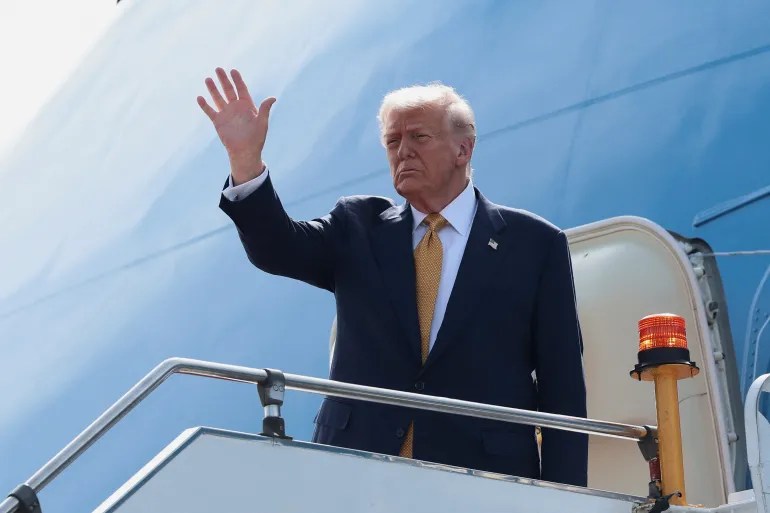
KUALA LUMPUR, Malaysia – October 27, 2025 – U.S. President Donald Trump departed the Association of Southeast Asian Nations (ASEAN) summit in Kuala Lumpur, leaving behind a flurry of new bilateral agreements but also a palpable sense of uncertainty regarding the region’s long-term trade relationship with the United States.
While the President lauded his trip as a success, touting new reciprocal trade and critical minerals agreements with Malaysia, Cambodia, Thailand, and Vietnam, regional policymakers are left to navigate a shifting economic landscape increasingly shaped by Washington’s transactional “America First” approach and the ongoing U.S.-China trade war.
Deals Signed, Tariffs Remain
A central feature of the visit was the formal signing of trade agreements with Malaysia and Cambodia and new frameworks for trade negotiations with Thailand and Vietnam. These deals are intended to address trade imbalances, secure supply chains for critical minerals, and provide preferential market access for some U.S. goods.
For Southeast Asian nations, the immediate priority was mitigating the steep reciprocal tariffs imposed by the U.S. earlier this year. The new agreements successfully lowered the blanket tariff rate for most exports from these four countries to around 19-20%, down from highs that reached nearly 50% for some nations. Malaysia, for instance, secured a zero-tariff rating for key products like semiconductors and pharmaceuticals.
However, the continued application of any significant U.S. tariffs—an average of 19% remains for many goods—leaves a cloud over the region’s export-driven economies. Analysts note that while the bilateral deals offer a short-term reprieve and a mechanism for continued dialogue, they run counter to the region’s desire for broad, stable, and predictable multilateral trade rules.
The Critical Minerals Play
A major win for the U.S. was securing commitments on critical minerals, particularly from Malaysia and Thailand. These agreements aim to diversify the global supply chain for rare earth elements and other strategic materials, lessening U.S. dependence on China. Malaysia specifically pledged not to ban or impose quotas on critical mineral exports to the U.S. and to work on developing its rare earth sector with American companies.
This focus underscores the increasing role of Southeast Asia in the geopolitical competition between the world’s two largest economies. While the deals present opportunities for U.S. investment and technology transfer, particularly in areas like aerospace and mineral processing, they also force ASEAN members to take a more defined position in the global supply chain competition, risking potential friction with Beijing.
Balancing Act Under Duress
The underlying question for Southeast Asia remains how to balance its need for deep economic ties with both the U.S. and China. The aggressive U.S. tariff policy has accelerated the trend of Chinese goods and manufacturing capacity shifting into the ASEAN bloc, using it as an alternative export hub to bypass U.S. duties. This practice, known as transshipment, poses a dilemma, as it simultaneously boosts intra-regional trade but risks a U.S. crackdown on “origin-washing.”
As the President heads next for high-stakes trade talks with Chinese President Xi Jinping in South Korea, ASEAN leaders can only watch and wait. While welcoming U.S. engagement—which also included President Trump’s role in the signing of a peace accord between Thailand and Cambodia—the unpredictable nature of Washington’s trade policy ensures that the region will continue its scramble to secure its economy through a combination of tailored bilateral deals and efforts to deepen its own internal economic integration. For Southeast Asia, the promise of a “free and open Indo-Pacific” now appears to be one defined by complex calculations and a perpetual balancing act.
 healthvibes.news.blog