
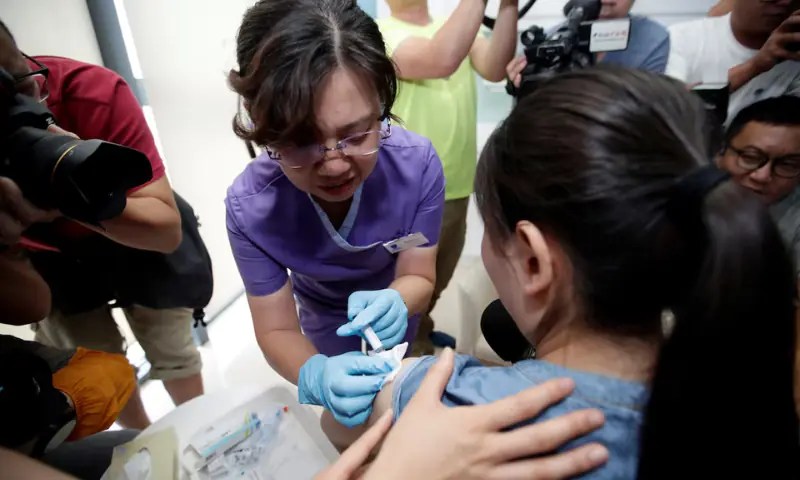
ISLAMABAD, October 8, 2025 — Pakistan’s landmark effort to vaccinate adolescent girls against the Human Papillomavirus (HPV) has achieved significant ground coverage, with over 9 million girls protected from cervical cancer, even as it battles a determined wave of online misinformation.
The national HPV introduction campaign, which commenced its first phase from September 15–27, 2025, faced immediate challenges as myths and false claims—particularly concerning infertility and the vaccine’s halal status—went viral on social media, leading to widespread parental hesitancy and a high number of initial refusals.
Overcoming Initial Setbacks
The initial phase of the campaign, which targeted 13 million girls aged 9–14 across Punjab, Sindh, Azad Jammu and Kashmir (AJK), and the Islamabad Capital Territory, saw early vaccination rates fall short of the ambitious 90% target. Early reports indicated that only about 34% (around 4.5 million girls) of the target had been vaccinated as the initial 12-day window closed, prompting an extension of the drive in provinces like Sindh and Islamabad.
However, a robust and sustained response by health officials and community workers led to a rapid turnaround:
- Progress on the Ground: By early October, reports confirmed that over 9 million girls had been protected, demonstrating a successful and energetic effort to build trust in communities.
- Trust-Building Strategy: Health workers engaged in patient, door-to-door dialogue to address parental fears directly. In some districts, refusal rates reportedly began dropping significantly within days, with acceptance climbing to 70–80% as community engagement efforts took hold.
- Public Advocacy: The federal Health Minister publicly vaccinated his own daughter on stage to directly counter “baseless rumors,” and the Health Ministry launched a counter-strategy of awareness videos featuring gynaecologists, celebrities, politicians, and religious scholars to validate the vaccine’s safety and efficacy.
The Challenge of Misinformation
The pushback was largely driven by a lack of public awareness about cervical cancer—the third most common cancer among Pakistani women, resulting in an estimated 3,000 to 5,000 deaths annually—and a pre-existing environment of vaccine skepticism. Common questions and fears included:
- “Will it cause infertility?”
- “Is the vaccine halal?”
- “Why is it free of cost?”
Health officials consistently reiterated that the HPV vaccine is safe, effective, and scientifically proven, endorsed by leading Islamic scholars, and is already part of the national immunization schedules in several Muslim-majority countries, including Saudi Arabia and the UAE.
Next Steps in the Campaign
Pakistan’s HPV vaccination program is part of the country’s commitment to the World Health Organization’s Cervical Cancer Elimination Initiative, aiming to vaccinate 90% of girls by age 15 by 2030.
The phased rollout is set to continue:
- Phase 1 (Completed/Extended): Targeted 13 million girls in Punjab, Sindh, AJK, and ICT in September 2025.
- Phase 2: Will expand to Khyber Pakhtunkhwa in 2026.
- Phase 3: Will reach Balochistan and Gilgit-Baltistan in 2027, aiming to protect over 17 million girls in total by 2027.
The free-of-cost vaccine is being administered through schools, health facilities, and outreach teams, with a particular focus on reaching out-of-school girls and those in high-risk, underserved populations. Despite the ongoing misinformation challenge, the dedicated work of thousands of health workers continues to secure a healthier future for millions of girls across the country.
 healthvibes.news.blog